Germany is the largest economy in Europe, and together with Austria and Switzerland it forms a market of roughly 100 million German speakers. Many companies approach it with confidence. The products are strong, the pricing is competitive and most German managers speak excellent English. Why bother translating at all?
The answer becomes clear the first time a proposal is quietly rejected, or a technical manual is returned with a polite list of questions. In the DACH region, language is not just a vehicle for information. It is a test of seriousness.
Clarity over charm
German business writing values precision. Sentences may be long, but they are built to leave no room for misunderstanding. Specifications are expected to be complete. Terms are expected to be used consistently from the first page to the last.
A marketing text full of enthusiasm and vague promises can feel unconvincing to German readers. They want to know exactly what the product does, which standards it meets and what happens if something goes wrong. A good translator does not just convert the English. They adjust the tone so it fits these expectations.
Formal and informal address
German distinguishes between the formal "Sie" and the informal "du". Most B2B communication, legal documents and official correspondence use "Sie". Some start-ups, fashion brands and tech companies use "du" to sound modern and approachable.
Choosing the wrong form is not a grammar mistake, but it changes how the brand is perceived. The decision should be made at the start of a project and applied everywhere, from the website to the invoice template.
Technical and regulated content
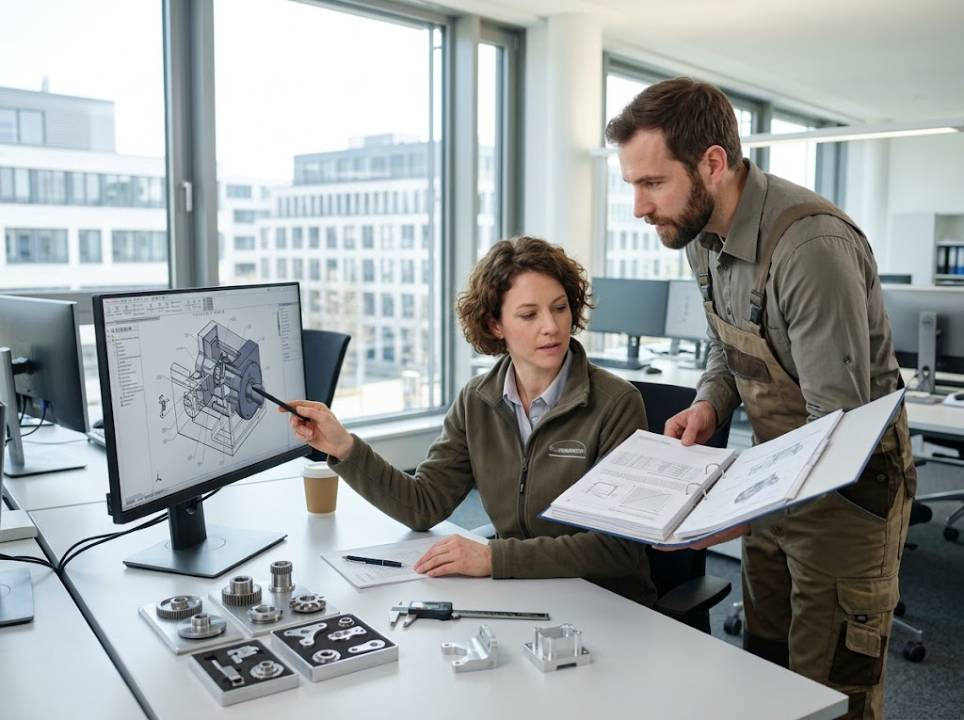
Germany has a strong industrial base, and a lot of translated content is technical: machine documentation, safety instructions, certificates, test reports. Much of it falls under EU directives and national rules that require clear, correct information in the local language.
For this kind of material, generic linguists are not enough. Professional german translation services assign engineers-turned-translators or specialists with years of experience in a given field, and run each file through a second review focused on terminology.
Compound nouns and terminology
German is famous for long compound words. A single term can combine four or five concepts that English would express as a phrase. This makes terminology management essential. If one translator writes "Sicherheitsabschaltung" and another writes "Notabschaltung" for the same function, the reader may assume they are two different things.
Teams that translate regularly keep approved terms in a central glossary and a translation memory. A dedicated tms tool makes that easy by storing every approved segment and showing it to translators automatically whenever the same phrase appears again, across projects, vendors and years.
Interpreting and language training
Written translation is only part of the picture. Negotiations, audits, trade fairs and works council meetings often require interpreters. In Germany, works councils have a strong voice in many companies, and important decisions may need to be explained to employees in their own language.
Many international firms also invest in language courses for staff who move to German offices. Even basic German builds trust with colleagues and customers, and it shows respect for the local culture.
A multilingual workforce
Germany's workforce is increasingly international. In recent years, a large number of people from Ukraine have settled in the country, many of them skilled professionals in healthcare, engineering and IT. Employers who hire them often need onboarding material, safety briefings and contracts in several languages.
A typical HR department may therefore handle German documents for authorities, English material from headquarters and english ukrainian translation of training and welcome packs, all at the same time. Coordinating these flows with one provider keeps terminology and deadlines under control.
Legal and official documents
German authorities usually require certified translations for official documents such as company registrations, powers of attorney, diplomas and civil status records. These are prepared by translators sworn or authorised by a German court. Their stamp and signature confirm that the translation is complete and accurate.
Requirements vary between federal states and institutions, so it is always worth checking with the receiving office before ordering. An apostille on the original document may also be needed.
Swiss and Austrian differences
German is not identical across the region. Switzerland does not use the letter ß and has its own terms for many everyday and administrative concepts. Austria has distinct vocabulary in areas such as food, law and public administration. For content aimed at a specific country, a local reviewer adds real value.
Practical tips
- Decide early between formal and informal address.
- Build a glossary of product names and technical terms before translating.
- Use native German linguists with subject-matter knowledge.
- Plan for text expansion, as German often runs longer than English.
- Check certification requirements for any official document.
A language worth the effort
German is one of the most widely studied foreign languages in the world and an official language in six countries, as the overview of the German language on Wikipedia notes. For companies that want to succeed in this market, careful translation is not an extra cost. It is one of the clearest ways to show German-speaking customers that you take their standards as seriously as they do.