Most organisations do not translate one document and stop. They translate a product manual, then its updated version a year later. They localise a website, then add pages every month. A law firm translates a standard contract, then dozens of variations of it.
In every one of these cases, a large share of the text has already been translated before. The question is whether anyone remembers it.
What translation memory is
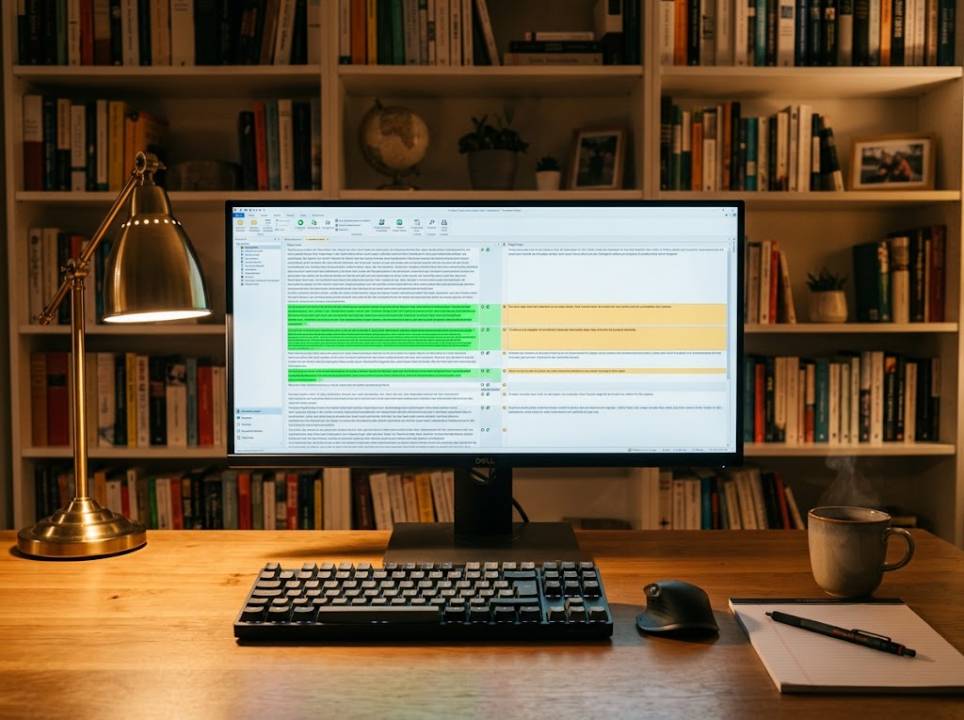
A translation memory is a database of sentence pairs. Each time a translator confirms a segment, the source sentence and its translation are saved together. When a new document arrives, the software compares every sentence against that database.
If a sentence is identical to one already translated, it is called an exact match. If it is similar, say 85 percent the same, it is a fuzzy match. The translator sees the earlier version and only needs to adjust the differences. New sentences are translated from scratch and then added to the memory for next time.
Where the time savings come from
Imagine a 40-page machine manual. Version two changes a few safety warnings, adds one chapter and updates some specifications. Without a memory, the whole manual might be sent for translation again. With one, perhaps 70 percent is recognised automatically, and the translator focuses on the genuine changes.
The same logic applies to e-commerce catalogues, software interfaces, financial reports and training material. Over months and years, the savings in time and budget become significant.
Consistency is the hidden benefit
Speed is easy to measure. Consistency is harder to see, but often more valuable. When different translators work on the same product line over several years, they tend to choose different words for the same concept. A memory shows each of them how a phrase was translated before, so the terminology stays stable.
For regulated sectors such as medical devices, pharmaceuticals or finance, that stability is part of compliance. For brands, it protects a recognisable voice across markets.
Language schools and training providers
Translation memory is not only for agencies. Language schools, universities and corporate training departments use it to manage course material in several languages. A lesson plan updated in German can be pushed into English, French and Polish versions quickly, with unchanged sections reused automatically.
Teachers and course designers also use memories as teaching tools, showing students how professional translators handle recurring structures and terminology.
Choosing the right tool
The market offers everything from free desktop programs to enterprise cloud suites. Looking for the best translation memory software usually starts with a few practical checks: which file formats it supports, whether several people can work on the same memory at once, and how easily data can be exported if you ever switch providers.
For larger organisations, the memory is often one part of a broader platform that also manages workflow, vendors and budgets. A proper translation management system comparison should therefore look beyond the memory itself and consider connectors to your CMS, user roles, reporting and pricing models.
Owning your memories
One question often gets overlooked: who owns the translation memory? If an agency builds it for you over several years, make sure you can receive a copy in a standard exchange format such as TMX. That way your investment stays with you, even if you change suppliers.
It is also worth cleaning memories from time to time. Outdated terminology, errors that were later corrected and duplicate entries can creep in. A well-maintained memory is more useful than a large but messy one.
When memory helps less
Not every text benefits equally. Creative marketing campaigns, literary works and one-off personal documents contain little repetition. Here the memory still helps with consistency, but the savings in time are smaller.
Official records are another special case. Someone relocating from Lyon to Toronto may need french document translation services for a birth certificate, a diploma and a driving licence. Each document is different and often requires certification, so the translator's expertise matters far more than stored matches.
A tool with a long history
The idea behind translation memory dates back to the 1970s, and commercial systems became common in the 1990s. The Wikipedia article on translation memory explains how the concept evolved and how today's tools combine it with terminology databases and machine translation.
Getting started
- Ask your current provider whether they keep a memory for your projects.
- Request an export in TMX format and store it safely.
- Send source files in editable formats so matches can be detected.
- Share glossaries and style guides alongside the memory.
- Review match reports on quotes to understand where savings come from.
Translation memory will not replace skilled translators, but it lets them spend their time where it counts. For any organisation that updates content regularly, it is one of the simplest ways to translate faster, more consistently and at a lower cost over time.