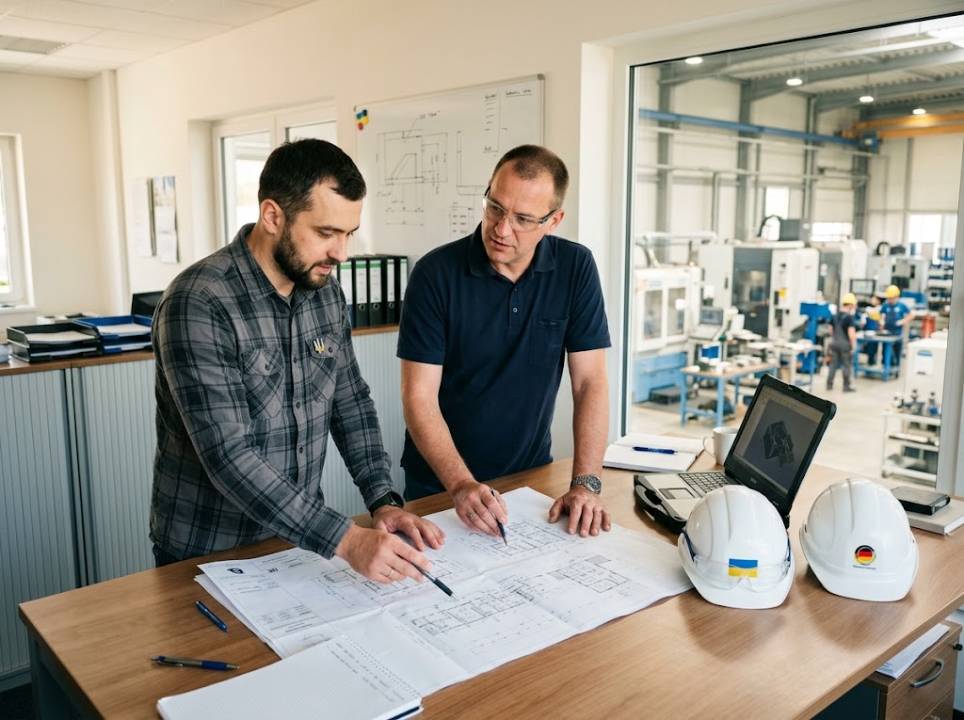
Germany needs skilled workers. Hospitals, engineering firms, logistics companies and IT departments report open positions they struggle to fill. At the same time, many well-qualified Ukrainians now live in Germany, and a growing number of employers are hiring them. Engineers, nurses, software developers, accountants and electricians are joining German teams every week.
The professional skills are there. What often slows things down is language, both in paperwork and in daily work.
The paperwork comes first
Before a new employee starts, a stack of documents needs attention. Diplomas, transcripts, employment records and professional licences must be understood by HR and, for regulated professions, recognised by the competent authority. German offices generally require certified translations into German, prepared by a court-authorised translator.
The official Make it in Germany portal explains which professions require formal recognition and where to apply. Checking this early saves weeks, since recognition procedures can take time.
English as a bridge language
Many international companies in Germany work in English. Their contracts, policies and training materials exist in English first, and German versions follow for legal reasons. For Ukrainian hires who speak English better than German, onboarding content in Ukrainian can make a real difference in the first months.
An experienced english to ukrainian translator can adapt welcome packs, safety instructions, IT policies and benefits information so that new employees understand their rights and duties from day one. This is especially important for safety-critical roles in manufacturing, construction and healthcare.
Russian and Ukrainian are not interchangeable
Some employers assume that Russian materials are good enough for Ukrainian staff. This is a mistake. Ukrainian is a separate language, and for many Ukrainians today, receiving official information in Russian feels inappropriate. Where staff come from several post-Soviet countries, it may still be useful to provide both languages, clearly separated.
Companies with teams from Kazakhstan, Moldova or the Baltic states sometimes need russian english translation for documents from those colleagues, while offering Ukrainian versions for Ukrainian staff. Respecting these choices signals professionalism and respect.
Keeping many languages under control
Large employers may suddenly find themselves managing HR content in German, English, Ukrainian, Polish, Romanian and Turkish. Updating every version when a policy changes becomes a real challenge. This is why many HR and L&D teams ask what is a translation management system and whether it can help.
In short, it is a central platform that stores all source content and translations, tracks changes and routes updates to the right translators. When the safety manual is revised in German, only the changed sections are sent for translation, and every language version is updated consistently.
Interpreting for key moments
Written translation covers documents. For important conversations, such as job interviews, works council meetings, medical checks or performance reviews, professional interpreters help avoid misunderstandings. Remote interpreting by phone or video is often available within hours and suits short meetings well.
Language courses as an investment
Translation and interpreting solve immediate needs. In the long run, German language skills are the key to integration and career progression. Many employers now offer or subsidise German courses, sometimes during working hours. Public integration courses and job-related language courses are also available.
Combining language training with translated materials during the first months gives new employees the best start. They can work safely and productively while their German improves.
Regulated professions need extra care
Doctors, nurses, pharmacists, teachers, lawyers and some engineering roles are regulated in Germany. Candidates must prove that their training is equivalent to German standards. Authorities examine course lists, hours of practical training and professional experience in detail. A translation that summarises or simplifies these documents can lead to extra exams or long delays.
Translators working on recognition files should render every subject, grade and hour exactly, explain Ukrainian grading scales where needed and keep the structure of the original. HR teams can help by collecting complete documents from the start, including annexes and diploma supplements, rather than sending them piece by piece.
Common pitfalls
- Assuming English or Russian materials are enough for all staff.
- Using machine translation for contracts or safety instructions.
- Starting recognition procedures too late.
- Forgetting to update translated versions when policies change.
- Relying on colleagues as informal interpreters for sensitive talks.
Family and relocation support
New employees rarely arrive alone. Partners and children need school places, doctors, residence permits and bank accounts. Companies that help with relocation often coordinate translations of birth and marriage certificates, school reports and medical records. This support reduces stress and helps new staff settle in faster, which in turn improves retention.
Building an inclusive workplace
Language is not just a practical issue. It shapes how welcome people feel. Employers who invest in clear, respectful communication in their employees' languages, while supporting German learning, build teams that stay longer and perform better. For a country facing serious skills shortages, that is not a nice extra, but a competitive advantage.